State: modelled: generated from the UDS ECU simulator's PDX and CDD and run against the simulator on CAN and over DoIP; generated from 12 public PDX files and five CANdela demo files, with the state charts and preconditions read as odxtools reads them. Not run against a real ECU or a production description, and not compared with CANoe.DiVa.
Generate the tests
Run Generate Diagnostic Tests... from the ECUs view's row menu, the context menu of a PDX, ODX or CDD file or its editor tab, or the Command Palette. It writes <variant>.diagtests.json where you choose, beside the description by default. The test file holds only what the description establishes:
- the ECU's session and security state charts and each service's preconditions and transitions (CANdela: the state groups);
- the baseline every case starts from, and how each session is reached;
- the timing (P2, P2* and tester present time of the variant's protocol). S3 is not in any description read, so
timing.s3Msis left for you, and the cases that need it skip until it is set; - the negative response codes a refusal may carry.
| Kind | What it checks |
|---|---|
| session | Each reachable session is entered within P2 (and P2* per response pending); the P2 and P2* the ECU reports are not longer than the description's |
| read | Each readable data identifier decodes with no bytes left over and every value within its limits |
| refused | Each restricted service is refused, with one of the description's codes, where it may not run |
| unlock | Each security level unlocks with the ECU definition's seed-key source |
| routine | Each routine starts and its response decodes; results are requested where the description has the service |
| readDtcs | DTCs read by status mask 0xFF decode, are named by the description and match their status availability mask |
| clearDtcs, reset | A positive response |
| write | Each writable identifier is written with the value read and read back unchanged |
| testerPresent, sessionHold, sessionTimeout | Tester present is answered; a session is held by tester present; without requests it times out after S3 |
Routines, clearing, resets and writes are marked as changing the ECU. Everything not generated is listed in the file's notGenerated with the reason.
Review, edit and regenerate
The test file is in the module's documented format, version 1, with a JSON schema. Its problems show in Problems at their place: an unknown setting, a request that is not hexadecimal bytes, two cases with one id, a file written for a later version, and a case that would change the ECU without "changesEcu": true. Set S3, leave a case out with "skip": true, or add cases of your own.
Regenerate Diagnostic Tests generates the tests again from the description, variant and ECU it names, opens a diff of the current and new text, and replaces the file only after you confirm, shown the description's new SHA-256 and the cases added, removed and changed. Your own cases, skips and S3 are kept.
Run it
In the Testing view, Diagnostic Tests shows one item per test file, its cases grouped by what they test, each at its line in the file; the run profile is Run on the ECU.
- Running a test file or group runs every case that leaves the ECU as it is.
- A case that changes the ECU runs only when chosen itself, after one confirmation that names the ECU, its interface, the test file and its SHA-256, and every such case with its request.
- Each case shows passed, failed with the reason, errored, or skipped with the reason, what it established, and every request and response with its time; all are in the Operation Log too.
- Responses are decoded through the description, checked against the SHA-256 recorded in the test file.
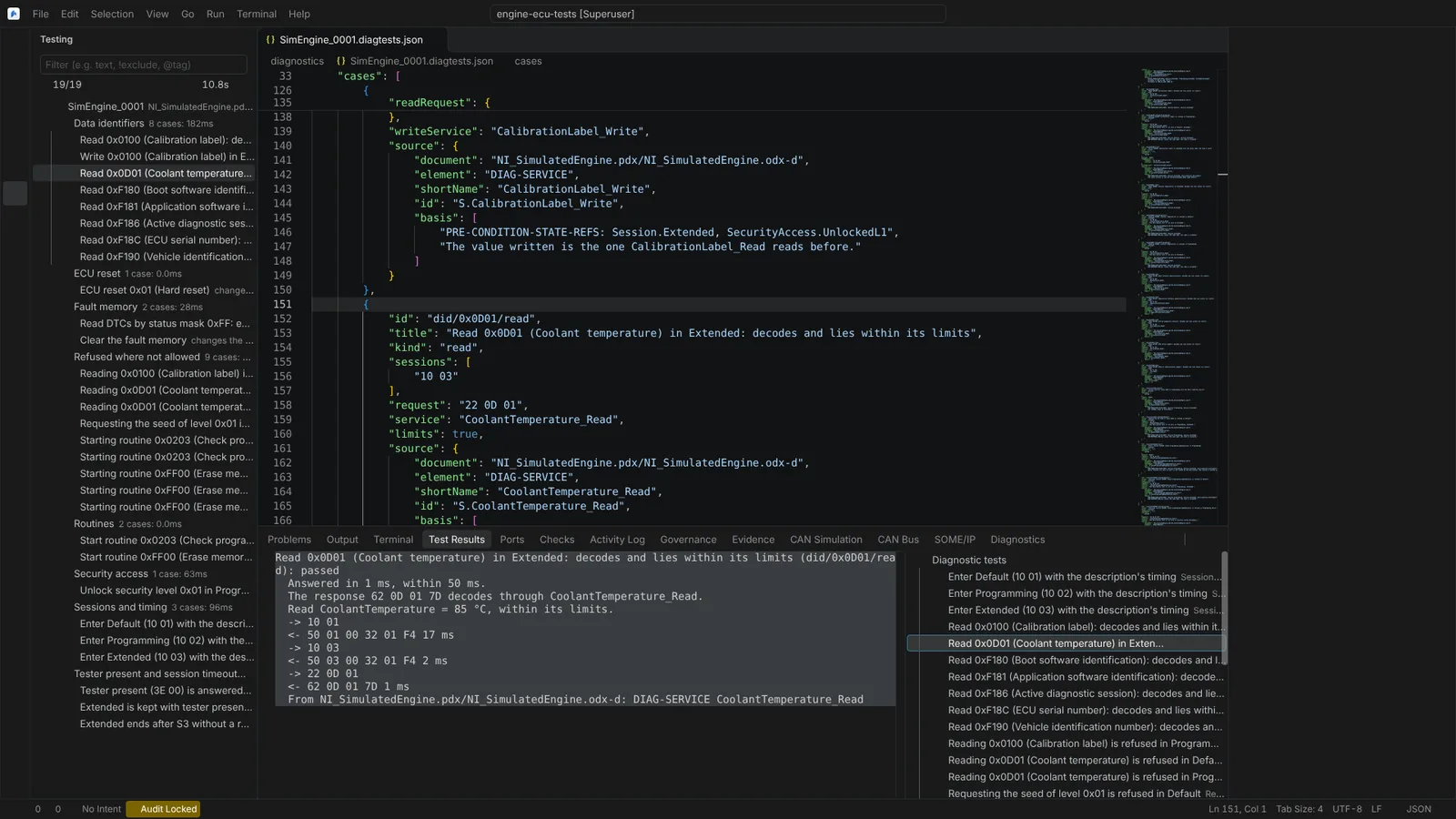 Diagnostic tests generated from the description, run from the Testing view with the request and response of each case.
Keep the evidence
Every run writes a record into build/diagnostic-tests/<name>/<start time>.json of the test file's workspace folder: the test file, the descriptions with their SHA-256, the ECU and interface, the identification read before the cases, the tool's name, version and commit, the cases confirmed and each case's outcome, requests and responses. Save Diagnostic Test Report... writes the latest run's report (an HTML page, CSV tables, the record and a provenance file). Requirements Coverage takes each case's latest result, and Link Test Case to Requirements... links a case (see Requirements coverage).
Agents use generateDiagnosticTests (writes the test file after the chat's confirmation) and runDiagnosticTests (the ECU-changing cases only when named, confirmed every time).
Not verified: the response time is measured at the tester, through the bus host and interface, so on a busy machine it is longer than at the ECU. No public ODX description restricts a UDS service to sessions, so refusals in ODX rest on the simulator's description. The two agent tools were not invoked in the running Editor.