State: clusters verified against autosar-data (an independent reader) and, for payloads, cantools, on descriptions written for the tests: no public ARXML with a FlexRay cluster was found. FlexRay frames in MDF 4 verified on recordings written by mdflib and read back by asammdf. No FlexRay hardware, live bus or customer project; not compared with CANoe's FlexRay option or FIBEX Explorer.
Read the cluster
The FlexRay clusters of an ARXML file, and the files it references (AUTOSAR_00049 and later), become the module's FlexRay model:
- the cluster's parameters (baud rate, cycle, macroticks, static slots and their payload, minislots, symbol window, network idle time, cycle count and the others), each as written;
- channels A and B;
- the ECUs whose communication controllers are connected, with their key slots (startup, sync, key slot only) and maximum dynamic payload;
- the frame triggerings with slot, base cycle and cycle repetition (1, 2, 4, 5, 8, 10, 16, 20, 32, 40, 50, 64) or cycle counter, senders and receivers;
- the frames, their PDUs and signals, read as CAN frames are, so multiplexed, secured and container PDUs, computation methods and units decode the same way.
Check it
18 rules report in Problems, on the .arxml file, among them: missing static slot, payload or cycle count parameters; a cycle that differs from its macroticks; segments longer than the cycle; channels without or with the same name; a triggering without timing or with a slot outside 1 to 2047; base cycles and repetitions the schema does not allow or that do not divide the counter's range; a dynamic slot the minislots cannot reach; two frames in the same slot of the same cycle on the same channel; frames longer than the static payload or the sender's dynamic payload; a sender not connected to the channel; key slot faults; more sync nodes than allowed. The ARXML layout checks apply to FlexRay frames too.
The FlexRay Cluster editor
Run Open FlexRay Cluster (Command Palette, or the title bar of an .arxml file that defines a FlexRay cluster). The editor is read only; edit the ARXML as text.
- Communication Cycle: a grid of slots by cycle for each channel, each cell the number of the frame sent then; frames sharing a slot in alternate cycles side by side, conflicts marked, key slots and the dynamic segment marked; a legend with one number per frame and where it is sent.
- Frames by Slot, PDUs and Signals, Nodes and the cluster parameters with the static and dynamic segments in macroticks and microseconds.
- The cluster's problems.
- A filter narrows every part to the frames, signals and nodes that match. Every name and value opens where it is written in the ARXML. Several clusters are picked from the toolbar.
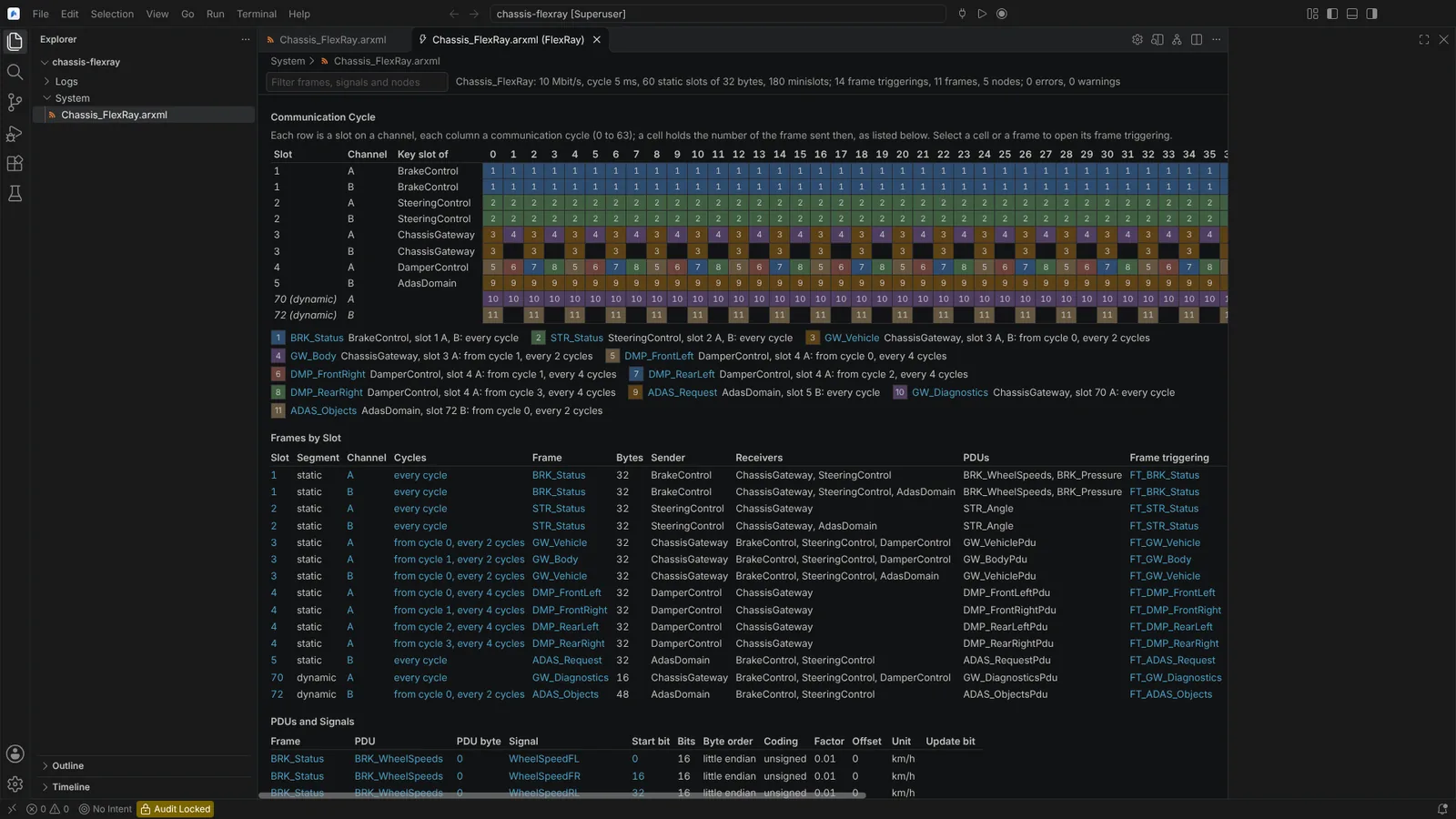 The FlexRay Cluster editor: the slot-by-cycle grid for channels A and B, with one legend entry per frame.
Decode a FlexRay recording
Open an .mf4 with Open as FlexRay Trace. The FlexRay Trace editor reads the FLX_Frame records of MDF 4 bus logging (payloads in signal data blocks or a VLSD channel group, compressed or not) and decodes each frame with a FlexRay cluster of the workspace: time, channel, slot, cycle, direction, frame, length and signal values with units. Frames the cluster does not place in that slot and cycle are marked. Filter with slot <n>, cycle <n>, A, B and words of frame and signal names. Opening a row opens the frame triggering in the ARXML.
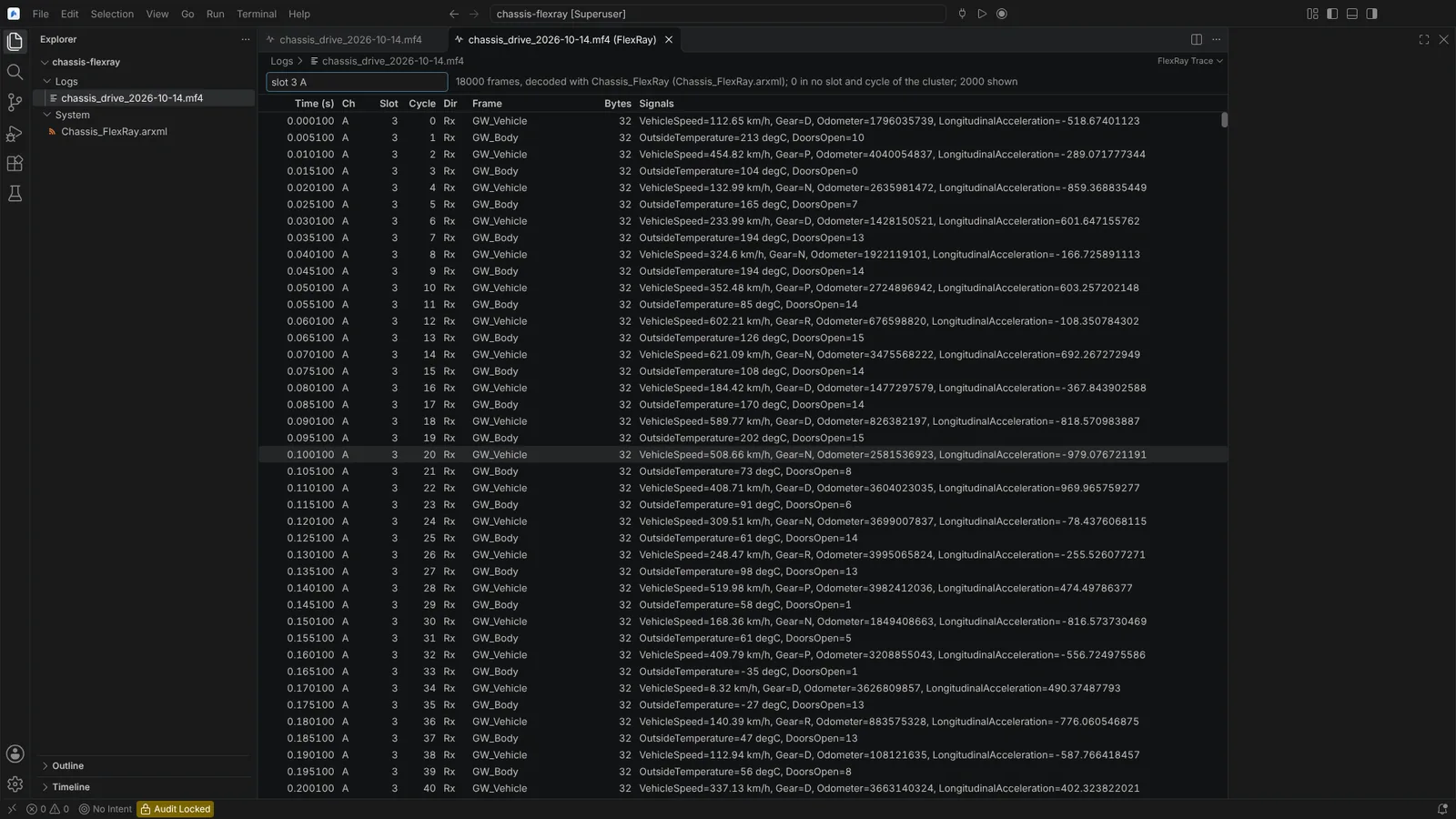 An MF4 FlexRay recording decoded with the workspace's cluster and filtered to one slot, its frames alternating by cycle.
Not verified: the MDF member names rest on mdflib, not ASAM's bus logging document; no file from a Vector, ETAS or dSPACE logger has been read; a logger that names the members otherwise is reported, not guessed. Only the first variant of a cluster is read.