Language intelligence for C and C++ comes from clangd, which you install yourself (version 17 or later). The module starts it for the active build configuration, so go to definition reaches into the CMSIS and vendor headers, target defines resolve, and the vendor's keywords do not show as errors. No Microsoft C/C++ extension or other marketplace extension is involved.
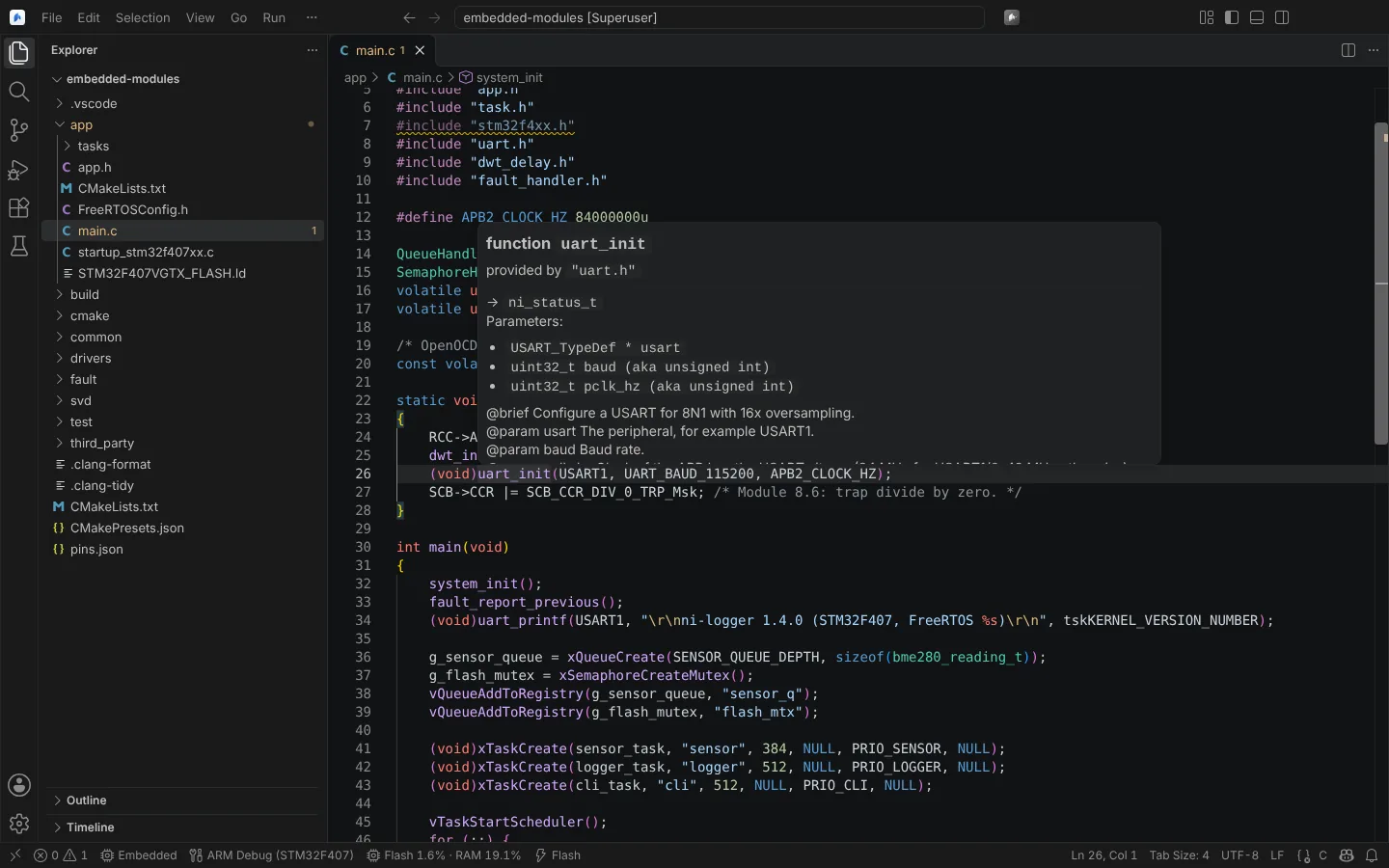 A clangd hover on uart_init with its parameters and the declaration's documentation comment.
How clangd is set up
The module runs clangd with background indexing, clang-tidy diagnostics, detailed completion and formatting, and:
--compile-commands-dirset to the folder of the active configuration'scompile_commands.json;--query-driverfor the cross compiler's folder (arm-none-eabi-*) and for Arm Compiler 6 (armclang*), so clangd asks the compiler for its target, system headers and predefined macros. Without it, CMSIS headers and target defines do not resolve.
neuralInverse.embedded.clangd.arguments adds your own arguments after these, so they win.
The status bar item C Language Support shows clangd's state and the configuration it indexes. If clangd crashes repeatedly (more than a few times in three minutes) it is not restarted; Restart C Language Server (clangd) starts it again, and the Embedded log says why it stopped.
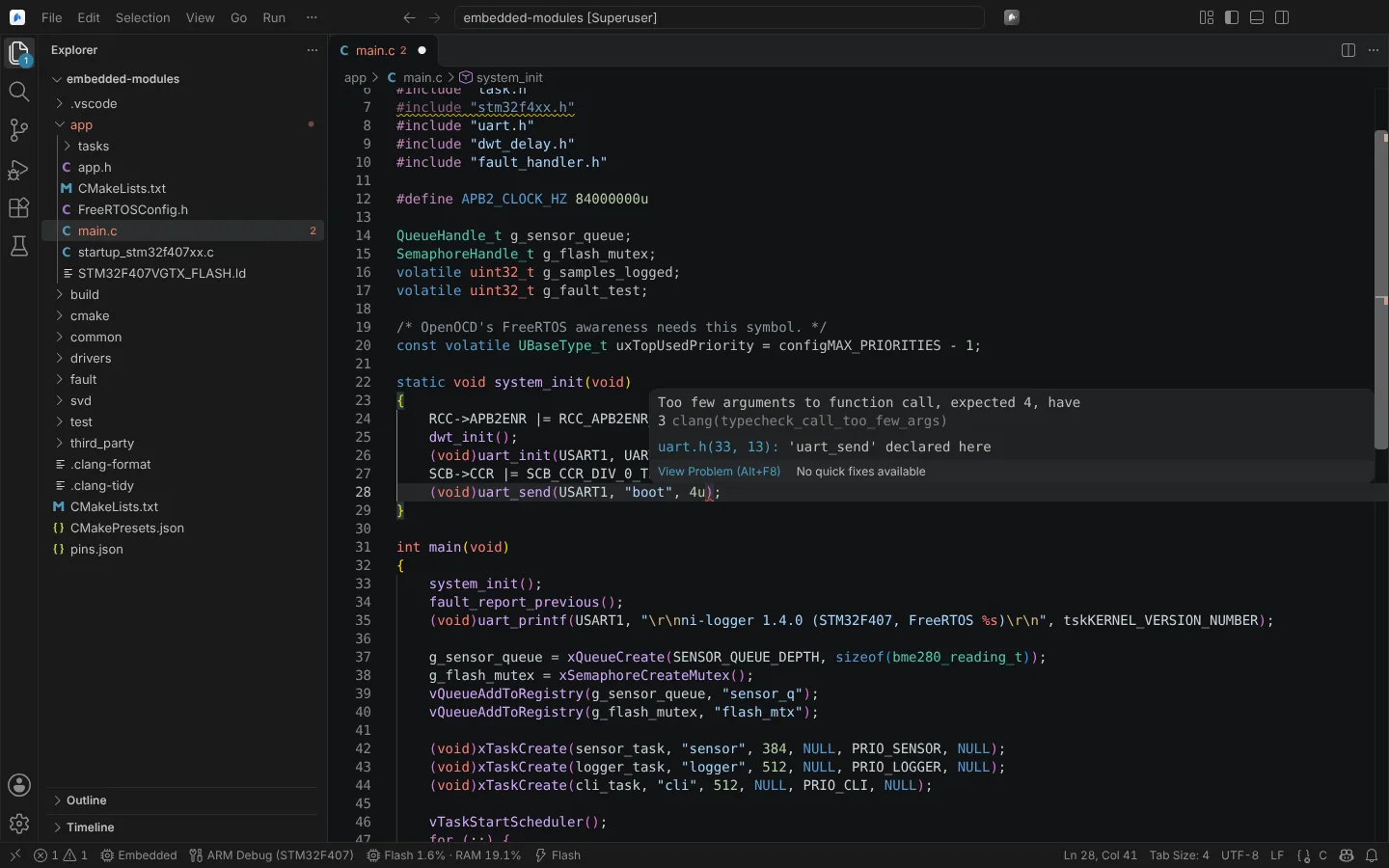 A clangd error typed into a call with too few arguments, linked to the declaration in uart.h.
Projects built with IAR
clangd cannot read iccarm command lines. For IAR projects the module writes a translated compile database:
- For an IAR project built in place, the compile commands come from
iarbuild -jsondb(Embedded Workbench 9) for the active configuration. For an IAR CMake project, they come from CMake. - Each
iccarmcommand becomes a clang command with iccarm's own predefined macros (read from its--predef_macrosoutput) and its system headers. - IAR's layout keywords get their GNU meaning:
__packedis__attribute__((packed));__no_initand__ramfuncget the sections IAR's guide names (.noinit,.textrw);__nakedisnaked;__interworkand__exceptionare defined away. - IAR writes
__packedbeforestructorunion, where clang ignores an attribute. In the text clangd reads,__packedis moved after the keyword (same length and lines): for open documents through the language client, and for other sources and the include folders' headers through rewritten copies in the build folder's.neuralinverse-clangd/folder. Your files are never changed.
State: unit-tested on an iccarm 9.50 command line and macro file. With Apple clang and clangd 15.0.0 run directly (not through the Editor, which requires clangd 17), packed structures and unions from IAR's guide pass their static size assertions with the translation and fail without it. Not yet run against iccarm (kit iar-clangd). A __packed followed by a line break before struct is not moved, and a header outside the include folders of the compile commands is read with IAR's layout only after the next configure or build.
Projects built with Arm Compiler 6 or GCC
- Arm GNU Toolchain projects: clangd reads CMake's
compile_commands.jsonand queriesarm-none-eabi-gccthrough--query-driver. - Arm Compiler 6 projects built through CMake: clangd queries
armclangthrough--query-driver. Arm Compiler 6's own keywords are not translated as IAR's are.
State: the argument generation is unit-tested; the clangd integration test exists and has not run in a verified audit. No clangd 17 or later has run in a verified audit.
Register hover
Hover a peripheral access such as GPIOA->MODER in C or C++ to see the peripheral, register and field details from the device's SVD file, with a link to open it in the Registers editor. See Peripheral registers.
Generated files and coding standards
Coding standards checks (organisation header, no dynamic allocation in chosen folders, no #pragma once) run on save and are described with static analysis: see Coding standards on save.